Welcome to Narcotics Anonymous of NJ. Our Message Is…
That an addict, any addict can stop using drugs,
lose the desire to use, and find a new way to live.
Helpline
If you feel you have a problem with drugs, call our helpline
Events
See upcoming NA events and activities in NJ
Narcotics Anonymous is a nonprofit fellowship or society of men and women for whom drugs had become a major problem. We are recovering addicts who meet regularly to help each other stay clean.
– Narcotics Anonymous Basic Text, page 9
Recovery from addiction is possible and available through the 12 Steps and 12 Traditions of Narcotics Anonymous.
Narcotics Anonymous is FREEDOM from active addiction.
Narcotics Anonymous is an international, community-based association of recovering drug addicts with over 61,000 weekly meetings in over 131 countries worldwide.

Just for Today
Ever have a day when everything seems to be working against you? Do you go through periods when you are so busy taking people's inventories you can barely stand yourself? What about when you find yourself snapping at your co-worker or loved one for no reason? When we find ourselves in this bleak frame of mind, we need to take action.
At any point in the day, we can set aside a few moments and take a "spot inventory." We examine how we are reacting to outside situations and other people. When we do, we may find that we are suffering from a plain old "bad attitude." A negative outlook can hurt our relationship with our Higher Power and the people in our lives. When we are honest with ourselves, we frequently find that the problem lies with us and our attitude.
We have no control over the challenges life gives us. What we can control is how we react to those challenges. At any point in time, we can change our attitude. The only thing that really changes in Narcotics Anonymous is us. The Twelve Steps give us the tools to move out of the problem and into the solution.
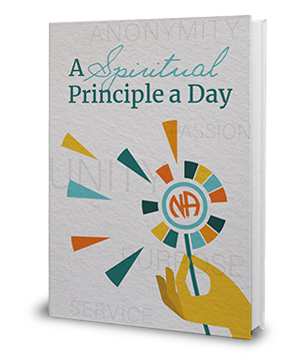
A Spiritual Principle a Day
Many addicts first hear our message of hope while incarcerated, often thanks to the hard work of our H&I trusted servants. One member shared, "When I got out, I heard someone share about a 'self-made prison,' and I was mad at first. They didn't know what it was like to be on the inside. But the more I came to meetings and heard addicts share about the disease, I realized that we had more in common than I thought. Just being out didn't mean I was free . . . yet."
Freedom comes in many forms. The ability to come and go freely as we wish, a right denied when or if we are incarcerated, is just one of those forms. We can experience mental, emotional, and spiritual freedom wherever we go--or wherever we stay. One member wrote, "I thought freedom meant doing whatever I wanted whenever I wanted, as long as I stayed clean. But I felt trapped by my impulses. I found it impossible to say no to myself, even when my behavior had consequences. When I told my sponsor I wanted to stop but didn't know how, they told me to sit with the impulse and see if I could learn something from it. I sat with it and didn't act on it, and I learned that I could survive the feeling. The feeling passed, and I felt light. I felt free."
The most obvious freedom we gain in recovery is physical--we gain freedom from our compulsive use of drugs. That physical freedom, that changed behavior, has a corresponding inner component--the peace of mind that comes with no longer being trapped in obsession and self-centeredness. We are free to think of something other than where our next fix is coming from. We are free to feel something other than despair. We are free.