Welcome to Narcotics Anonymous of NJ. Our Message Is…
That an addict, any addict can stop using drugs,
lose the desire to use, and find a new way to live.
Helpline
If you feel you have a problem with drugs, call our helpline
Events
See upcoming NA events and activities in NJ
Narcotics Anonymous is a nonprofit fellowship or society of men and women for whom drugs had become a major problem. We are recovering addicts who meet regularly to help each other stay clean.
– Narcotics Anonymous Basic Text, page 9
Recovery from addiction is possible and available through the 12 Steps and 12 Traditions of Narcotics Anonymous.
Narcotics Anonymous is FREEDOM from active addiction.
Narcotics Anonymous is an international, community-based association of recovering drug addicts with over 61,000 weekly meetings in over 131 countries worldwide.

Just for Today
For many of us, the past is like a bad dream. Our lives aren't the same any more, but we still have fleeting, highly charged emotional memories of a really uncomfortable past. The guilt, fear, and anger that once dominated us may spill into our new life, complicating our efforts to change and grow.
The Twelve Steps are the formula that helps us learn to put the past in its place. Through the Fourth and Fifth Steps, we become aware that our old behavior didn't work. We ask a Higher Power to relieve us of our shortcomings in the Sixth and Seventh Steps, and we begin to be relieved of the guilt and fear that plagued us for so many years. In the Eighth and Ninth Steps, by making amends, we demonstrate to others that our lives are changing. We are no longer controlled by the past. Once the past loses its control over us, we are free to find new ways to live, ways that reflect who we truly are.
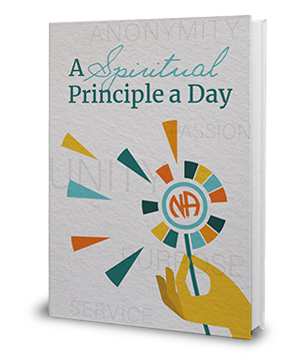
A Spiritual Principle a Day
WHO AM I?
As cliched and psychobabbling as that question may seem, many of us will identify with having asked it--and having not known the answer. Or, more to the point, we didn't want to know.
In active addiction, many of us could have answered the question like this: "Anyone you want me to be, baby."
And right after getting clean, "Nobody!" might have been the most accurate response, considering the shame we were feeling and how invisible we wanted to be in meetings.
Denial had kept us from accepting the truth of our actions and their impact on ourselves and the people who love us. Many of us paid the price for this lack of self-awareness with the loss of relationships, careers, assets, even our freedom.
The recovery process allows us to start contemplating our true identities, and it takes all the honesty we can conjure up, along with a healthy dose of courage and humility. We learn to accept that we've caused pain and injury, have done damage to ourselves and others while on our destructive paths. We also learn to accept that we aren't the sum total of those actions.
Recovery affords us the opportunity to use the hardships we've endured to help others. We divulge our deep personal struggles--those from our past and those that will inevitably arise while clean--in order to deepen our relationships with other addicts. In doing so, we show our fellow addicts that we can stay clean--no matter what.